Jumat, 29 Januari 2016

Yellow boat 4 FPV camera view Purau New Zealand 2 1 14

,


Yellow boat 4 mostly Hobby King bits balsa epoxy fiber glass hull 
http://kiwitricopter.blogspot.co.nz/2012/09/3-hour-yellow-boat.html


Twin Turnigy 450 Series 3800KV Brushless Outrunner Helicopter Motor
RPM: 3800kv
Max Current: 35A
Max Power: 365W

2 X HobbyKing 30A BlueSeries Brushless Speed Controller with shared enlarged air cooled heatsink with an 30mm fan
Cont. Current: 30A
Burst Current: 40A
http://www.hobbyking.com/hobbyking/store/uh_viewitem.asp?idproduct=13429&aff=652823


coupled to modified NQD jet drives with flex shafts and custom 3 blade impellers 

ZIPPY Compact 2700mAh 3S 25C Lipo Pack
Capacity: 2700mAh
Voltage: 3S1P / 3 Cell / 11.1V
Discharge: 25C Constant / 35C Burst
Weight: 203g (including wire, plug & case)
Dimensions: 137x15x44mm
Balance Plug: JST-XH

http://www.hobbyking.com/hobbyking/store/uh_viewitem.asp?idproduct=21349&aff=652823

Purau
https://www.google.co.nz/maps/preview#!q=Purau%2C+Canterbury&data=!4m15!2m14!1m13!1s0x6d322f14fc09c6a3%3A0x500ef868479e4b0!3m8!1m3!1d338144!2d175.3085223!3d-37.6203018!3m2!1i1366!2i642!4f13.1!4m2!3d-43.6390402!4d172.7489035

Yellow boat 4 FPV camera view Purau New Zealand 2-1-14 from nickatredbox on Vimeo.


Read more

A Bigger Boat

,


ILENE is sitting on her mooring while we are cruising from Amsterdam to St. Petersburg and back on the Celebrity Constellation along with our brother and sister in law, Mike and Linda, and 2030 other folks, the boat being filled to capacity -- plus near 1000 crew. She is 965 feet long; her beam is 105 and her draft is 26. And she outweighs ILENE  9100 to 1.
Our cabin, though on starboard, was third deck, the second row of  large round portholes (just below the life rafts, about three forward of the very large ones portholes under the enclosed exterior black elevators.
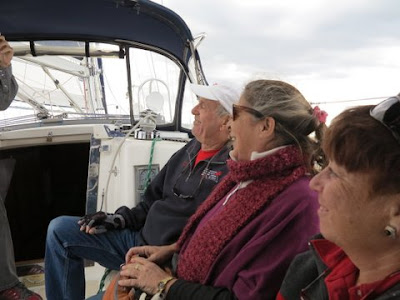
Roger, Mike, Lene and Linda with cast on her arm 
This is our sixth cruise -- almost all with my brother and or Lenes, and their wives. The pleasure of behemoth cruising pales compared with cruising ILENE. The big advantage of the big boats is they go to places that we will never otherwise get to and the hotel is moved at night while you sleep with no watches to stand or navigation issues to resolve and there is no packing, unpacking and getting to and from airports or railroad stations. Food is prepared and served, the room is professionally cleaned by our smiling steward who remembers my name and there are countless and varied shipboard entertainments.

We have missed about half of the evening night club-like shows. This is partly because we are day people to which night clubs are less of an attraction and partly due to our proximity to the land of the midnight sun. One night we got to the theater after dinner and saw that the show was wrapping up. "Well stay for the second show," said I. "This is the second show" was the response. But while it was almost 11 PM,  it was still light outside, creating the illusion of 7:30. The traditional "sailors midnight", i.e., sundown, gets thrown out the window here.

The food, while good, has never again achieved the dazzling excellence that we recall from our first such cruise of the Eastern Caribbean on a Princess ship about fifteen years ago. The excellence of that first time experience may be a creation in my mind, and back then I ate like a pig while now I am conscious of a desire to limit the number of pounds that this vacation will add to my personal tonnage. (Actually, my first weighing after returning home showed a gain of seven pounds.) Mercifully, the "midnight buffet" is a thing of the past, a victim of both cost cutting and peoples increasing consciousness of the perils of extreme obesity. But the buffet is open about twenty hours per day.

This boat was built twelve years ago but was recently refurbished and looks pristine. Newer ones have larger gyms to accommodate a greater percentage of health conscious cruisers. We took in a stretch class almost every morning and  worked out in the gym and visited to the sauna or steam room almost every day.

Too many of the "entertainments" are infomercials for the products and services that the ship is forever trying to sell. I have a personal prejudice against being "sold". When I want something, Ill ask for the help of the salespersons suggestion. But unsolicited sales help makes me less likely to buy the advertised product or service. On the boat they have art lectures to try to sell you art, gaming lessons to try to increase their casino business, tours of the galley to try to get you to dine, for additional fees, in the several specialty dining rooms which used to be free, and lectures on wines and liquors to induce sales of drinking cards. We are very poor customers in the eleven different bars because the two women do not drink at all and Mike and I have only a very occasional beer or glass of wine. And we have not patronized the mall of shops. And the ships land excursions are very heavily promoted too, and not a good value. I learned from my brother, Allen, years ago, that especially when you have a group (we are four) you can do better with your own locally sourced tour guide or taxi driver than with the expensive tours that the boat pushes. This lesson was driven home in Amsterdams airport, where we met a Celebrity greeter who told us that their special private direct shuttle to the boat cost only $38.00 per person.  But Mike told us the better way. The local railroad station runs under the airport and for $4.00 you get a ticket to Amsterdams central station with only a beautiful fifteen minute waterfront walk to the boat.
My three companions love to play cards and are quite good at this; they like to play with me because I am a good loser. Lindas arm was in a sling this whole trip and I became her "card holder".

The best thing about cruising the sailing vessel ILENE is that we can make our own schedule. If we like a place we can stay a while. If storms threaten, we stay put. Before I was retired I did not have the benefit of almost unlimited time. Neither does Constellation. She is on an extremely rigid fixed schedule with one "day" in each port except two in St. Petersburg and this cruise has four "at sea" days among the twelve.  Many people do not like these "at sea" days but as long as I have my book and good companions, they are fine by me. And we will end up having visited seven nations, six of which are new for me.

The exception is Germany, birthplace of my father, in which, during a Danube River cruise a few years ago, we visited Regensburg and Nuremburg, in the southeast. This voyage included a lengthy fifteen hour visit to the seaside resort town of Warnemunde, near the ancient Hanseatic League port of Rostock, in the northeast.  That day our dockside visit extended to midnight to accommodate more than half of the passengers who took a seven hour round trip bus ride costing about $200 per person in order to spend a few hours in Berlin. We took a ferry from our dock in Warnemunde  to the heart of Rostock for $10, and after several hours of wandering among the churches, 
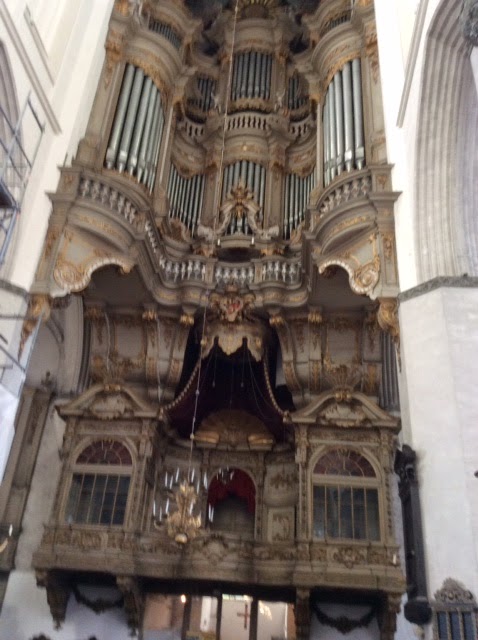
Huge organ above clock
Clock with 135 year calendar
gates to the ancient city,
its galleries, university etc.
A $3 train ride brought us back to Warnemunde. I was quite conscious that this was my first ride on a train in Germany, but this was not in a cattle car. Germany is indelibly stained in my mind by its Third Reich, and I cannot help but look for references to this abhorrent period. But I found none here in Rostock other than the account for what had been rebuilt after the bombing of 1942.


They reverse our "red, right returning" rule in the placement of the buoys in the Baltic.

This is the former communist East Germany but the spirit of capitalism is thriving with innumerable food, lodging, clothing, novelty, souvenir and every other type of store. The volume of the shipping traffic past our boat including both freight and passenger boats plus many sailboats from marinas in this port was very heavy. This and the next picture are from the top of the old lighthouse


Warnemunde is a beachfront resort.

I just liked the looks of this Dutch style gaff-rigged low-aspect ratio sloop with her brown leeboards up (instead of a keel). 


Read more

October 10 21 ILENEs Floating Season Ends

,
All good things must end. Having lived aboard during the first 146 days of 2015, during last winters Florida adventure, 2015s boat days will be a good number. (See next post.) The twelve day period reported on in this post saw (A) ILENEs final three sails, (B) four work days and (C) GOC.
Lets start with the sails. One was with Rhoda and Lloyd, of the Harlem. We have sailed with many times in the past. We were underway about four hours, and I confess that due to poor note taking, the wind and our course regrettably escape me.
Next was with four residents of my apartment building. I started out planning to sail with Dorothy, who is a fellow client of our personal trainer. That morning he mentioned that another couple in our building who trained with him, Mort and Rollie, had said they would like to sail some time. "Call them right now and ask about today; we leave at noon!" He did and they are in! But Dorothy was not feeling up to it today and requested a rain check for next season. "Sure." And now, including me, we are down to three souls. But on my way back to our apartment I saw Max, who shares a wall with us; he is in the next apartment.  He had to check with Ellen and two minutes later, my bell rang and our party had grown to five. Max purchased a picnic lunch for us all and we ate aboard, before getting underway -- while waiting for wind. Then there was only a ghost of wind, but it built, out of the north, and we got almost to Execution Rocks before heading back. We enjoyed four hours underway and three of the four guests took a turn at the helm. Mort is a professional oenophile who praised the bottle I served aboard and brought another to my apartment to replace it. Rollie, Mort, Max and Ellen:
ILENEs final sail of the season was also the final gathering of the Old Salts, including several of the regulars, and two special guests. We were underway for 3.5 hours, and got about a mile past Ex. Rocks, peaking at 7.4 knots. This was rather amazing given how foul ILENEs bottom was. (See below.) Thanks, Larry, for the next two photos. Here are Dave, Marti and Marcia:
Next is Dave, doing what racers do: checking the sail trim, with Art at the helm
Readers of this blog will recall Marti, who I have named The Goat Lady of Grenada. She has a long history of animal care and is volunteering there to help raise goats to develop a chevre cheese industry. She showered us with such great hospitality there during 2011. I had known that she was coming to the Big Apple for a visit and saw that she had arrived via a Facebook posting. It turns our she was staying in a friends apartment only a block away. I did not have her phone number but instant messaged her at about 10 a.m., and picked her up an hour later. She fit right in and has the ability to do that wherever she is. Our other honored guest was Dave, an excellent racer and now in charge of qualifying members who want to use the boats that the Club owns. I have long desired that he sail on ILENE, figuring I would learn something, and I was not disappointed.

With Lene in Israel, I had no date for the Clubs annual end of season gala, and Marti was able to gin up a suitable outfit despite having left all her dressy clothes in "The G," as she calls Grenada. It was a cool Saturday evening, warmed by the camaraderie of our members. Memorial plaques were set in the flag pole base for Al, a loyal Old Salt who moved to Florida two years ago, Tom, whose death I had not heard about, and Vinny, who I sailed with up the Hudson at the end of the season, perhaps ten years ago. The cocktail hour was long and delicious with good quality wines, and the sit down dinner was also great except for the perennial problem we experience: our kitchen is just not adequate to serve that many people at the same time. Our servers brought eight plates at a time to serve all the people at one table at the same time, but the last table was not served until amore than an hour after the first. The trophies to the winners of the races were duly warded. As Fleet Captain, I described the highlights of the Clubs cruising activities, thanking Bruce and Diane for designing the Club Cruise itinerary. I regret that I forgot to summarize the Old Salts season and to thank Mark for his help in reinvigorating the group.

(The next day was chilly and I escorted Marti on a tour of lower Manhattan via rented CitiBikes, my first experience with this program. I got an appreciation for the problems of cyclists in the City, with the paint marking the bike lanes significantly worn away and motorists infringing them even when marked. The thirty minute time period causes tension - finding the docking stations, though they let you take another bike two minutes after you drop off the last. We used three bikes to get from Tenth St to the Brooklyn Bridge and Chinatown, to the Hudson and Freedom Tower and back, stopping for a warming lunch in Chinatown.)


The first of the work days was the Clubs annual fall work party. I got enlisted into a group of four who painted the yard car,
by which boats on cradles are transported around in the boat yard (parking lot). After about twenty years of service it looks like new. I love these work parties because you get to know people who you only vaguely recognized before. And a delicious free lunch is always served.
Having loaded the two pieces of ILENEs canvas winter cover from the locker to the cart to the launch and to the boat, I motored from the Harlem to the Huguenot, about five miles, in no wind to speak of, entering through the western passage, passing the NYACs club house. After docking I stripped and bundled up the two headsails and removed the battens from the mainsail.
Next day I stripped off the main and after tying it to itself, heaved each of the three huge sail bundles from the boat onto the dock. Then they are, one at a time, lifted into a dock cart, wheeled about 150 yards to the parking lot, lifted into my car and driven to the Doyle sail loft on City Island, for repairs, cleaning, proper folding and winter storage. That same afternoon ILENE was lifted from the water revealing the terrible condition of her bottom.

Keel is bearded! Too many sandy landings in the last 18 months.
But power washing by Orlando and scraping that I did cleaned it off and she sits blocked and steadied by jack stands. Some of the black bottom paint is completely gone, with the blue paint underneath showing through.

The fourth work day, five hours, began with an inspection of a blasting of the bottom paint using tiny glass particles (except for the aft portion that I barrier coated two winters ago). David, using a powerful air compressor, did the forward three quarters of the hull in two hours for a very well spent $1175. Based on how long it took me to do the back end two winters ago, I saved about 25 days of back breaking, dirty and dangerously unhealthy work. A bargain. A photo of the newly white bottom will be added to this post soon. That same day I tried to winterized the engine, air conditioner, heads and fresh water system, which was very frustrating, because I had done this in the past but kept getting stuck. I also removed the lifelines and stanchions and rigged the "ridge pole" for the canvas cover (whisker pole, boom and a board from the aft end of the boom to the radar arch) in preparation for installing the cover. The next post will describe a sail from Essex CT to Hampton, VA, which kept getting delayed by equipment problems and weather. Many work days are ahead.

Read more

Header Photo Australian Vee Jay Dinghy

,


The previous header photo was of the Australian junior class, the Vaucluse Junior, aka the Vee Jay, or simply the "VJ". A 12-foot dinghy, the Vee Jay was originally designed in 1931 by Sydney boatwright Charles Sparrow to a design brief for a junior sailboat given to him by local sporting-goods store owner, Sil Rohu. It was a simple low-angle V-shaped hull, plank and frame construction, readily built by amateurs. The pre-World War II hulls had a small cockpit, similar to the North American Sunfish class.

What makes the class stand out was its transformation after World War II. The adoption of plywood in the late 1940s considerably lightened the hull and sailors started adding planks; the first plank (sliding seat to North Americans) added in the late 1940s but not coming into common usage until the 1950s. The second plank was added by the West Australians in 1958. The small cockpit disappeared, replaced by a self-draining surfboard deck. Combined with a small flat kite (shike), this junior dinghy had enormous power and speed in a breeze - unlike any junior trainer, before or since. (Historian Chris Thompson points out this Australian penchant, after World War II, to incorporate performance upgrades, even to supposed one-designs, even when all the previous models became immediately obsolete, was one of the main drivers in the evolution of Australian lightweight high-performance dinghies.)

The class collapsed in the 1980s under the hegemony and homogenization of fiberglass junior trainers (namely the 420).

I have taken most of my information and photos from the Vee Jay website. For those who wish to read more I would direct them to click on this link to their website. I would also like to thank Aussie, John Fairfax, for also filling in the history and providing photos.


Some additional photos.

The first design by Charles Sparrow was named Splinter. Deciding the first hull was too tender, Sparrow drew up a wider modified hull the same year named Chum from which commenced the VJ class. The original boats had a gunter rig.


Two photos of the simpler, 1930s hiking Vee Jay.


The squat sail plan was easily handled by lightweights in the typically strong Australian breezes.


To me, the most iconic photo of the Vee Jay, "Warren Nupier in Impala"


A promotional brochure with the Vee Jay at full crack, under kite.


This photo shows the final development of the Vee Jay before the class died out (the boom looks shorter with a straighter leech mainsail). There was a recent movement, documented on the Vee Jay website, of bringing back the class with a more modern sail plan, but that hasnt seemed to gain much traction.


A photo lifted from South Gippsland Y.C. of a restored Vee Jay racing at their 2015 Classic Wooden Dinghy Regatta. This is a one-planker, just for the skipper.


A 1950s video showing two juniors rigging, launching, and sailing their Vee Jay.


Ed. Sea Story

"As a young sailor, during the 1970s, I came across a Vee Jay on Annapolis Harbor. I saw this strange craft buzzing about the Harbor, two sliding seats, as we sailed our International 14 out to the starting area. On our way back after the racing, we encountered the same double sliding seat dinghy and sailors again. this time entwined in the fishing lines of two irate fishing boats, the air turning blue as the skipper was working desperately under his rudder. Inquiries on shore had the sailor as someone from the Australian embassy. I never saw him again; most likely the encounter with the fishing boats left a bad taste in his mouth.


And another sea story Ive pulled from the comments... from Northwest sailor Mike S.

"When I moved to Oz in 1965 with wife and daughter in tow, aged 21, I couldnt afford a boat, but someone was selling an old VJ with cotton sails and twin planks for only 10 quid, so I couldnt resist. It was a hoot albeit pretty rough around the edges, and as I didnt have a crew I jury rigged a trapeze (stitched my own canvas harness!) and sailed it singlehanded from the trap. Great fun on Lake Illawarra with steady 15-25 knot breezes every day. Its demise happened during a race, I got a crew and we sailed with the planks, some time during the race the wind piped up, and the old plywood started to open up, with us slowly sinking. We abandoned the boat, climbed aboard the rescue boat and left it to float to the shore. I went the next day and brought it up, but it was too far gone.....Had a metal daggerboard as I recall....

Click here for the post about the other Australian pre-WWII class, the Len Morris scow Moth.

Read more

Interview With Boat Designer John Simpson

,
Interview with John Simpson 

John Simpson has been a boat designer for 45 years. I had a chance meet him at a Metal Boat Festival a few years ago. Now every time I go to one I look forward to hearing him speak. He has a vast knowledge of boat design and is always willing to share that knowledge.

John, you have been a long time member of the Metal Boat Society and contributor to the Metal Boat Quarterly, thank you for your years of support.


DB: When did you get into boating?
JS: My first boating experience was at 4 years old with my dad in an open 16’ rental boat with inboard engine.

When did you realize you wanted to design boats for a living and how did you become a yacht/marine designer?
Even though I had been sketching out boats for several years and had been boating since 10, it was during a university summer job maintaining 3 naval utility vessels (75’, 48’, and 36’) that design and construction got into my blood stream. My first step was to interview several naval architects to get a feel for the business. All were very helpful and one suggested the best path was to marry a rich woman (I didn’t). I did another summer job in a boatyard leading to a 4 year marine design/drafting and engineering apprenticeship at a shipyard where we built several ferries & barges and at that time, the world’s largest semi-submersible oil rig. At completion I had jobs with several naval architects designing yachts, fish boats, dredges, barges, etc. Around 1972 (incorporated 1974) I started doing my own design work and topping up wages working with a boat builder.
Could you tell us about your first commission?
The ‘first’was a 70’ steel schooner shortly followed by a 33’ fuel efficient motor cruiser(s). Both are still in service

Since that first commission, how many boats have you designed?
By my records about 110 – sail, power, commercial ranging in size from 17’ to 80’ in steel, aluminum, and FRP. Some designs evolved from originals so the total number is higher.
This may not sound like a lot of designs over 40+years  but keep in mind that some designs can be complicated and if they need to meet Government Regulations, must be diligently monitored throughout construction… this and outside consult work absorbs time.

Not only do you have experience designing, but you have experience in building. Could you tell us about your boat building experience? 
From a bare hull: a 9’ sailing dinghy & a 22’ sail boat. Plus, 2 years with one builder followed by 3 years doing custom power boats 30’ – 50’, the latter as foreman, estimator, assistant manager, & designer.   

What lessons  have you learned from building that have helped with your design work?
Try not to design what one boss called an “Architect’s Dream”… ie: impossible to build. It was obvious that the designer had no boatbuilding experience and little boating experience.   I was just getting into my own design business and my ‘boss’ gave me some good advice:
 Never forget that one day:
(a)You may have to build one of your designs.
(b) You may have to use one of your designs.
I have done both on several occasions

As a designer you are well versed in not only yachts, but commercial vessels. I hope our readers will go to your website  http://www.simpsonmarinedesign.com and take a look at your portfolio. What are some of the challenges with commercial designs that are not present in recreational design?
The challenges are very similar but commercial boat (fishboats, etc) owners often push the limits, sometimes at great risk: Overloading, improper loading, or sailing into harm’s way, is not uncommon.  Not all boats are the same.
What are some of the challenges with recreational and cruising designs?
Very similar to commercial vessels: Different boats (designs) have different characteristics and each must be used within its limits. Putting a hot-tub on the housetop of a pontoon type house boat might be fine but on a motor cruiser, it may not be an option.

Any tips for the amateur builder looking at designs and wanting to build their own
boat?
(a)Choose the right design by getting some boating experience.
(b) Work up a realistic schedule – with particular attention to time. Unfortunate as it is, I have seen many cases where the ‘boat project’ outlived the builder.
(c)  Don’t underestimate the price. If your dream is a $500,000 yacht, you are not going to build it for $150,000. (not to the same standards at least.) 
(d)  Concentrate on the boat and not the parts. Building your own parts (windows, port lights, engine conversion, etc.) could be a poor investment of time: That 10 year project might stretch into 20…. And never get completed!
(e)  Use marine parts & equipment – it is designed for that purpose. Boats equipped with automotive and/or domestic equipment may put you at risk. 
(f)    Get the ‘other half’ involved- being a “boat widow” is not fun.
(g)  Pay now…or .. Pay later. Doing it properly the first time is a good investment. Corrections later can sometimes be very costly…. If they can be done at all.


Any tips for anyone wanting to modify a design of an existing boat?
Be very cautious: small changes can sometimes have huge consequences. Work with a naval architect/designer (preferably the one who did your boat)

Could you tell us about your consulting services you offer?
This covers wide variety of services ranging from performance estimates, propeller sizing, stability evaluation, to a design check (a review of the design with a second opinion).

Anything on the drawing board you want to tell us about?
A small project for a client that did a circumnavigation in one of my designs. They want to go from ‘offshore’ to ‘inshore’.  It is a 30’, easily transportable sailing punt to be used for exploring various inland waters in North America & beyond.


The Boat Plan Copyright © 2016 -- Powered by Blogger